
Rule of thumb: A broadly accurate guide or principle, based on experience or practice rather than theory.

A friend once emailed me asking how long a fuel canister for an MSR Pocket Rocket-type stove lasts in the backcountry.
I quickly typed an answer. One I’ve given many times before.
My friend astutely noted that it seems like I’ve done this once or twice before.
Indeed I have!
Over the years, I’ve spent a lot of time backpacking and developed “rules of thumb” for common questions or scenarios.
As with all rules of thumb, they are broad overviews. They’re meant to answer common questions with basic guidance.
Many exact-number-minded backpackers miss that when someone asks a simple question, they’re usually looking for a rough, reasonably accurate idea.
The person does not want to know the airspeed velocity of a swallow if one is nearby or how many minutes of simmering a person could achieve on their back deck (Who is timing how long it takes to boil water in the backcountry? And if you are timing how many minutes you get out of a canister while in the backcountry, I really don’t want to hear about it!) and so on.
Instead, here are some common questions and rules of thumb. I don’t claim they are scientifically accurate. They are just good enough for most people who want real-world advice based on using gear, not setting it up in the backyard for testing. 😉
Originally written in 2016; updated in October 2026.
***
- How long does a fuel canister last when used with an MSR Pocket Rocket (or similar) isobutane canister stove?
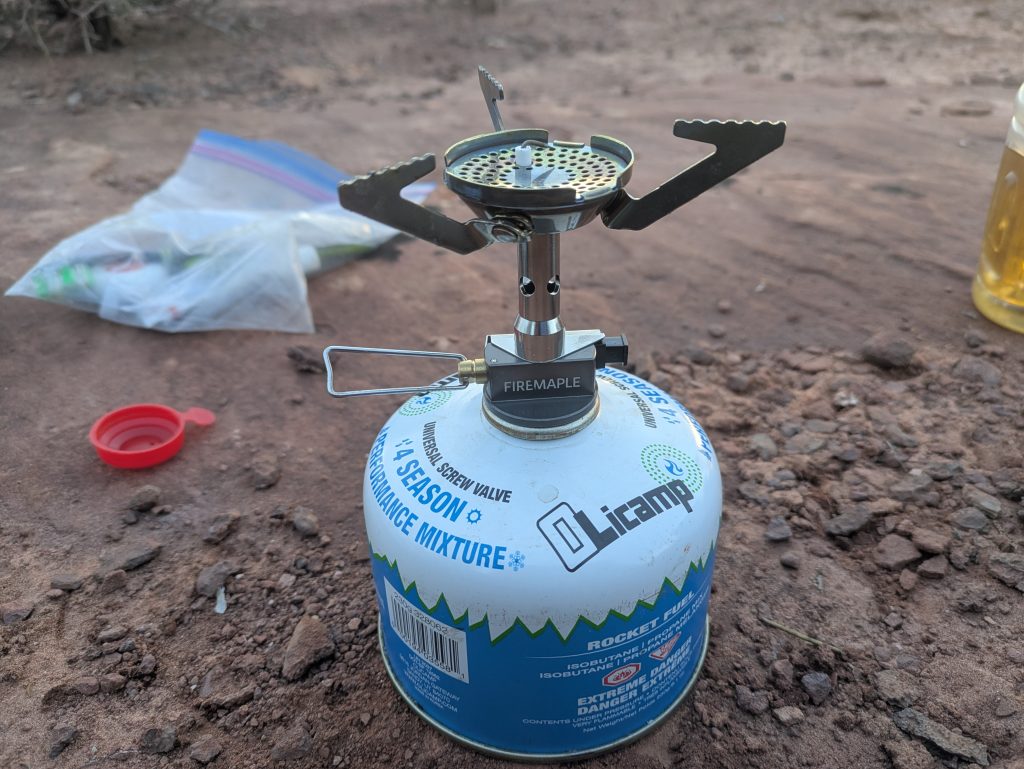
If you’re curious, here are the stoves we use in 2026.
There are many variables, of course. How cold is it? Is there a lot of wind? Do you have the stove on full blast or a slight simmer? For most people, though, in typical three-season backpacking conditions with a medium-to-low stove setting, I find a pretty consistent answer: a 4 oz / 100 g fuel canister will last about 10 boils.
I think in terms of boils, as that is how people generally “cook” on backpacking trips. Obviously, if someone is sautéing veggies, frying fish, or what-have-you, they’ll use more fuel.
So, to answer the question, assuming a typical backpacker meal is three cups of heated water (two cups for the meal, one for the hot drink), a 4 oz fuel canister will last ~4-5 days if doing two meals a day. Adjust the math if doing one hot meal a day, no hot drinks, cooking for two, or using a larger canister. Cold-weather conditions are another ball of wax, of course. But most people asking this question aren’t planning to backpack in winter.
Exact? No. Realistic for most? Yes.
If you want to dial it in a bit more precisely, BaseCamp Gadgets made a cool little (and free!) fuel calculator.
- How long will it take to hike Cool Trail up Awesome Mountain?

Free stock photo
Another common question with many variables. How long will it take to hike a trail?
A seasoned trail runner will blast up the mountain. Someone who hikes a long trail once every two years and does little in between may not even make it up. Altitude, route conditions, etc., also factor in.
But for a reasonably active person carrying an average pack weight and used to the elevation, the old formula from many guidebooks still works well for any maintained single-track mountain or even rolling-hills trail: two miles per hour, plus an additional half-hour for every 1,000 feet gained.
In the real world, if you hike 14 miles with 4,000 feet of elevation gain, plan on about 9 hours total, without breaks, for the average hiker. Simple. ‘Eh?
A more experienced, fitter hiker can probably go a little faster, naturally. But for someone just starting out, the rule of thumb above works well.
Of course, as I found out over the past decade, desert and canyon hiking is more three-dimensional, and the math skews. A caveat for this type of hiking is that I start thinking in terms of hours hiked rather than overall mileage. Off-trail miles aren’t the same as trail miles.
Canyon country often means three-dimensional hiking. You think less in terms of miles and more in terms of hours wandering, unlike a traditional AllTrails route or a well-known thru-hike.
The bends of the canyons and the scrambles off the canyon floor lead to places you would never reach in a straight, linear walk.
And sometimes the distance traveled isn’t the point at all…
- How much water should I carry?

Historic drawing
Until you dial in your backpacking, a conservative rule of thumb is to carry 1 liter per 5 miles hiked between water sources. Dry camping? Carrying an extra three liters for camping seems to work well (1.5 liters for dinner and drinking that evening, plus 1.5 liters for breakfast and getting to the next water source in the morning. Naturally, carry more if that next water source is farther away.) Of course, if you cook dinner at a water source and then hike to a dry camping spot to sleep, you need less water for camping. But that’s another discussion.
- How big of a pack do I need?

Found via GIS on Pinterest
A happy medium exists between the minimalist sub-1 lb packs and the gargantuan 100-liter monsters many people still think they need for a weekend on a well-maintained trail.
If you pack what you need, and perhaps a few luxury items, a roughly 60-liter pack is a good happy medium for most people. It’s small enough for weekend jaunts, but big enough for shoulder-season trips and multi-day trips. They’re usually not overly heavy and offer more support than more minimalist packs. Popular packs in this category include the ULA Circuit (one of my all-time favorites!), the Osprey Exos 58, the Granite Gear VC 60, and the Gregory Zulu, among others.
- How big of a tent should I get?

This 15-person Mountain Hardwear tent is only $5,500!
A one-person tent is just big enough for one person and little to no gear.
A two-person tent is spacious for one but tight for two… but perfect for one person and a dog.
A three-person tent is about right for two grown adults.
A rule of thumb? For the types of tents sold at REI, figure out how many people you need to fit, then add capacity for one more. In other words, pack a three-person tent if you’re going for two!
Lightweight tent manufacturers such as Six Moon Designs or Tarptent tend to have more spacious designs. These companies also offer more size options. Some of the designs are very minimalist. Others are spacious even for two.
- How thick of a sleeping pad do I need for warmth when backpacking?

from YouTube
Don’t think about thickness; think about R-value and the conditions you are seeing. R-value matters more than the pad’s thickness for warmth, if not always comfort.
Not sure what R-value means? Read something I wrote earlier and come back. Go ahead. I’ll wait.
Now that you know what R-value means, here are some rules of thumb for the minimum R-value you need. Obviously, colder sleepers may wish for a higher R-value in their pads. A thicker pad is more comfortable, obviously. Different body types and preferences mean comfort levels are subjective. However, these rules of thumb do work for warmth.
Nighttime lows of 40°F or warmer? An R-value of 1.5 to 2.0. Blue foam pad or similar. People who use minimalist pads should know how to pick camp spots that maximize their gear’s warmth and utility.
Shoulder-season backpacking where temps dip to about 25°F or want an all-purpose pad? Get a pad with an R-value of 2.5- 3.0. The Z-Lite and Therm-a-Rest are two classics in this category, light and not terribly expensive. Some, like the NeoAir, are considered lighter and more comfortable by many, but they’re expensive. This category is the sweet spot for most and fits many backcountry conditions.
Deeper shoulder season? A pad with an R-value of 3.0-4.0 is usually recommended. I personally consider deeper shoulder season to be when it dips to around 15°F. Usually late September or early October in the Colorado high country. I make do with a Z-Lite, but many prefer something with a better R-value. A less expensive solution? Combine it with a thinner, lightweight foam pad to boost the R-value. A cheap way to make your sleeping pad system more versatile.
Winter? 5.0+. I combine my Z-Lite, a Neo Air, and a sun shield together for a warm, versatile, and reasonably lightweight sleeping system. Newer winter-rated pads are also an option.
- How long will my mobile device last between charges in the backcountry?

Old-school green army man toy.
Most use their mobile devices as part of their backpacking toolkit. Smart devices take decent to very good photos, help with navigation, and offer many field-appropriate apps. Among other uses.
But how long will this golly-gee-whiz technology last in the field? It all depends.
However, if you keep the phone in airplane mode (Sorry, Instagramming your selfies you take on your EPIC JOURNEY OF SELF will be far more difficult), have the screen on the dimmer side, take the occasional GPS reading and rely mainly on your map and compass skills, take snaps and not videos, and perhaps do some light reading at night, a mobile device will last about four to five days between charges.
If you are a heavy GPS or app user, tracking yourself for making maps, filming videos, or trying to Instagram your #liveauthentically photos on a one-bar 4G connection, you’ll need an Anker box or similar for more frequent mobile device use. In general, a compact 5,000 mAh “lipstick” charger works well for moderate use when you need a recharge; a 10,000 mAh box works best for videos, heavy app use, and complex navigation in the field.
- “Saving pounds is cheap; saving ounces is expensive.”
Something I’ve preached the gospel of for almost two decades now. Swapping a sleeping bag for a lighter quilt, adding a good pad, choosing a comfortable pack suited to your trip goals, and carrying a lighter shelter pays off quickly. But then you start getting into the weeds. Is it worth shaving 100 grams or a few ounces for $100? $200? More?
Only you can answer that question, but as a rule of thumb, the more you pay to save weight, the more diminishing returns you get in the field. A new pack that’s half the weight of your older pack might cost $250. On the other hand, you can pay around $1,000 for a DCF tent that’s marginally lighter than the popular Durston X-Dome 1+ for about half the cost.
In the words of a favorite book:
“Do not be in a hurry to spend money on new inventions. Every year there is put upon the market some patent knapsack, folding stove, cooking-utensil, or camp trunk and cot combined; and there are always for sale patent knives, forks, and spoons all in one, drinking-cups, folding portfolios, and marvels of tools. Let them all alone”
***
Those are a few quick tips and rules of thumb I’ve picked up over the years. Hope this Q&A grab bag was helpful!
Great post! I boil more water than some, walk more slowly than some, have a pack that’s a little over 60 litres because packs are a few litres more in a Long torso, have one of those lightweight tents that’s a touch more spacious, carry an inflatable pad (plus a sunshade and a blue foam when the temps dip), and have a power-hungry hiking style (GPS track logging and photography). Your advice fits me pretty closely. For all the above reasons, I come in at the “heavy and slow” end of your range on most of the items, mostly making… Read more »
Paul, you have done this once or twice haven’t you? ;)))))
Great basics brother, your right on point. I love your musings. Keep it coming. You help so many of us!!!
Thanks for the kind words. 🙂
I just wanted to say I effing love you man. Your blog has been my go to source of info as I begin my backpacking journey. I love how straight forward you give information and I also have a good laugh at some of the photos. Anyway it has been a great help to me, so from a fellow Coloradoan, Cheers!
Thanks for the kind words! Best of luck on anyour future backpacking jaunts.