
Outlook does not look good.

Joan and I spend a lot of our free time poking around the red rocks of the Moab area. We see what we always see this time of year. More graded roads. More signage aimed at visitors. More infrastructure creeping outward from park boundaries.
None of this shocks me. But these trips line up with other data points that, taken together, sketch a decades-long trajectory that now seems to be accelerating.
Public lands are increasingly treated as economic resources to be extracted and exploited.
When leadership treats public lands as a revenue stream, everything else becomes negotiable.
I’m certainly not the first to see it, but recent events have accelerated the trend.
Customers, not citizens.

From Groupon.
A senior Department of the Interior (DOI) official recently visited Moab and spoke at a business summit. Coverage framed parks as economic engines tied to hotels, gas, and regional commerce. No surprise. The gentleman has no public-lands management experience and worked as a senior leader at Morgan Stanley.
Gateway communities have always depended on park tourism. That part is not new.
But the language keeps shifting. Visitors become customers. Parks become assets. Access becomes service delivery.
That single word, customers, does heavy lifting. It nudges public lands away from common ownership and toward a market model.
Once you see that shift, other pieces fall into place.
I wrote about this framing drift in Pay-to-Play on Public Lands. The trend has only deepened since.
The closed-door room
From a little-known movie about a New York-based olive oil importing business.
Last year, DOI held a closed-door summit in Salt Lake City with business leaders from gateway regions. Park Service staff attended as observers. Tribal representatives and scientists did not sit at the table.
That composition tells its own story.
If you center commercial stakeholders in strategic conversations about parks, you will get commercial priorities. More access infrastructure. More motorized or paved routes and more UTV access. More concession opportunities. More visitation and fewer perceived barriers to entry, such as timed entry.
We are not in tin-foil-hat territory. Incentives alone drive the outcome.
The consolidation pattern

No snark I can write will beat the absurdity of this LinkedIn photo.
DOI consolidated HR and IT across agencies. On paper, that move improves efficiency. In practice, consolidation often precedes outsourcing. I saw this pattern in my corporate past lives.
Centralize first. Contract later.
I would not be surprised to see fee collection and some visitor services move further down that same path. Recreation.gov already pushed parks toward a pay-to-access model run by Booz Allen. Expand that logic, and you get more privatized transactions sitting between people and public land.
The nomination

From the BBC
Now add the current nomination to run the National Park Service, covered in this National Parks Traveler report.
The nominee previously represented Delaware North, a corporation that held major park concessions and asserted intellectual-property claims tied to park lodging names.
That lawsuit mattered. It established how a concessionaire could frame park-related assets as corporate property rather than public heritage.
Perspective follows experience. If you spend a career inside concession finance and branding disputes, you will view parks through that lens.
The optics land hard.
Fox. Henhouse. You get the idea.
I joked that we may someday see Yosemite Valley at Google Place. I meant it as gallows humor. I am not entirely sure it stays a joke.
The corporate-parks entanglement is not new. The trajectory now feels like it’s picking up speed.
For historical context, this older Washington Post piece on Yosemite branding disputes shows how long this tension has existed.
The slow return to the 1920s

Mr. Monopoly
None of this started recently. Early park development leaned heavily on railroads, lodges, and destination tourism. I called this the “1920s recreation model” years ago. Money bought easier access then. Money buys easier access now.
We drift back toward that template.
High-amenity services with heavily managed visitor corridors. Increased motorized access with more commercial services clustered around scenic icons. Backcountry becomes an afterthought.
Add modern branding and digital reservation systems, and you get the same structure with better marketing.
I explored these ideas previously. The parallels feel stronger today.
Moab as a preview
From the City of Moab.
Around Moab, you can watch the layers overlap.
More road work aimed at vehicle access.
More concession pressure in high-use zones.
Mining claims at park edges.
Timed entry is going away, creating the kind of frustrating experience where “something must get done.”
Staff reductions paired with extraction-friendly messaging.
Individually, each item has its own justification. Collectively, these items trend in one direction.
Enter Coalie
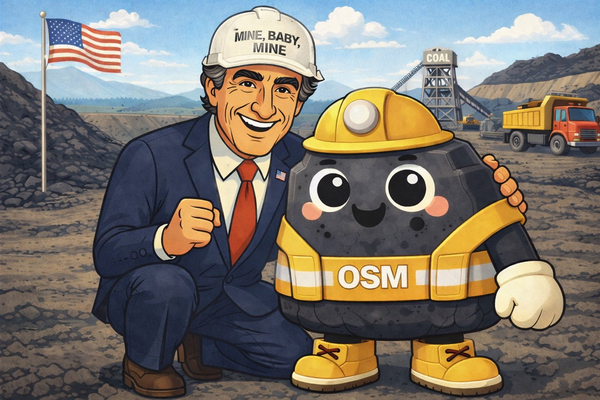
A federal rollout introduced a cartoon coal mascot while proposing rollbacks to mining oversight and staffing. If that sounds Onion-esque, you are not alone.
On its face, Coalie looks like another PR gimmick. But it signals something deeper: Public-lands messaging increasingly pairs extraction with friendly branding. Resource development becomes heritage. Mining becomes community. Industrial policy gets wrapped in a smiling character.
That narrative shift matters. It reframes public land from a shared civic landscape to a resource platform with a recreational overlay and, in the end, an overlay for even more economic extraction.
Cartoon mascot on one end, new mining claims outside Arches on the other. The through-line is not subtle.
On walls and expanded security

The border wall in Organ Pipe Cactus National Monument.
Then there are the walls.
Federal plans now call for new border barriers across much of the Rio Grande corridor through the park and surrounding region, with environmental review laws waived to speed construction.
The waivers set aside NEPA, the Endangered Species Act, the Clean Water Act, and multiple cultural-resource protections to allow expedited construction of walls and roads across roughly 175 miles of the Big Bend sector.
This pattern already played out in Organ Pipe Cactus National Monument. Border-wall construction blasted through Monument Hill and cut off Quitobaquito Springs from its historic hydrologic connection to the Sonoyta basin in Mexico, while severing ancestral Tohono O’odham travel routes that long predated the international boundary. Ecology, history, and culture all take the hit.
Public land becomes an infrastructure corridor.
Conservation law becomes an obstacle.
An industrialized security footprint starts to feel inevitable.
Long trails do not escape this shift, either.
The southern terminus region of the Continental Divide Trail threads a complicated route through New Mexico’s Bootheel, where border barriers and patrol infrastructure shape movement across the same desert landscapes now targeted for expansion.
Further west, the Arizona Trail has already seen segments rerouted or constrained by border-barrier construction and associated enforcement roads and closures along the boundary.
At the far western edge, the Pacific Crest Trail physically meets the border wall at Campo. The Pacific Crest Trail Association documented ongoing access and management complications tied to border infrastructure. Further restrictions continue.
Different parks. Different agencies. Same trajectory across the borderlands.
When processes get short-circuited for expedient ends, what else happens next without laws and oversight?
EDIT Feb 23 – And this announcement just came out – “Trump Administration Delivers Historic NEPA Reform, Unleashing Resources on America’s Public Lands”
For decades, NEPA has been twisted into a weapon to block American energy, infrastructure, and conservation projects.”
Timed entry and learned frustration
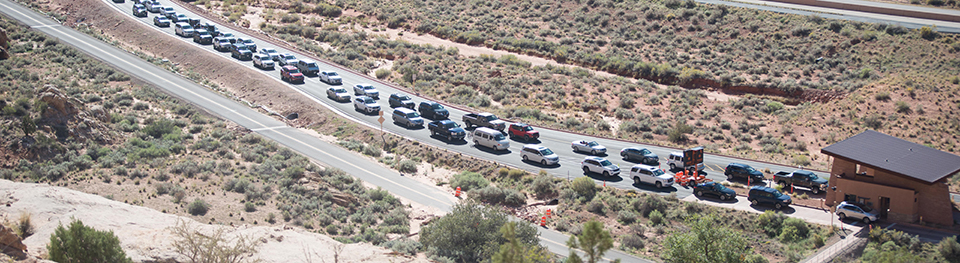
From Arches National Park, 2018. Before timed entry.
Timed entry, to no surprise, is vanishing. Many visitors dislike it. I understand why. In theory, the freedom to go when you want sounds ideal.
But removing capacity controls without adding stewardship capacity creates congestion and a degraded experience. People then accept private management solutions that promise efficiency.
That sequence matters.
First, overload the system. Then offer a privatized order. It is an old playbook.
This is not abstract politics.
Some readers prefer “no politics” in outdoor discussions. I understand the impulse. I go outside to escape the noise, too.
But governance shapes access. Funding shapes staffing. Policy shapes roads, permits, and preservation.
If you care about how you experience public land, you already sit inside the policy outcome whether you follow the politics or not.
Where this leaves us

From Wikipedia
I do not think parks will become theme parks overnight. Many good people inside the agencies still hold the line every day.
But the trends point toward more corporatization, more outsourcing, and more tourism framing.
Tourism dollars become another resource to extract.
The Magic 8 Ball answer does not look great.

From Threads
I hope I am wrong. Public lands shaped my life and gave me a path that someone in my background never would have considered. I do not want public lands to become another ROI line on someone’s financial forecast.
There are more issues than public lands in our current environment, and many are more pressing: socioeconomic and racial inequality, violence in our streets, rising costs of housing and food, and broader economic instability.
But it all returns to a theme from my formative years that still shapes how I see the world: caring for our common home, benefiting society as a whole rather than the few.
The long arc of history gives hope
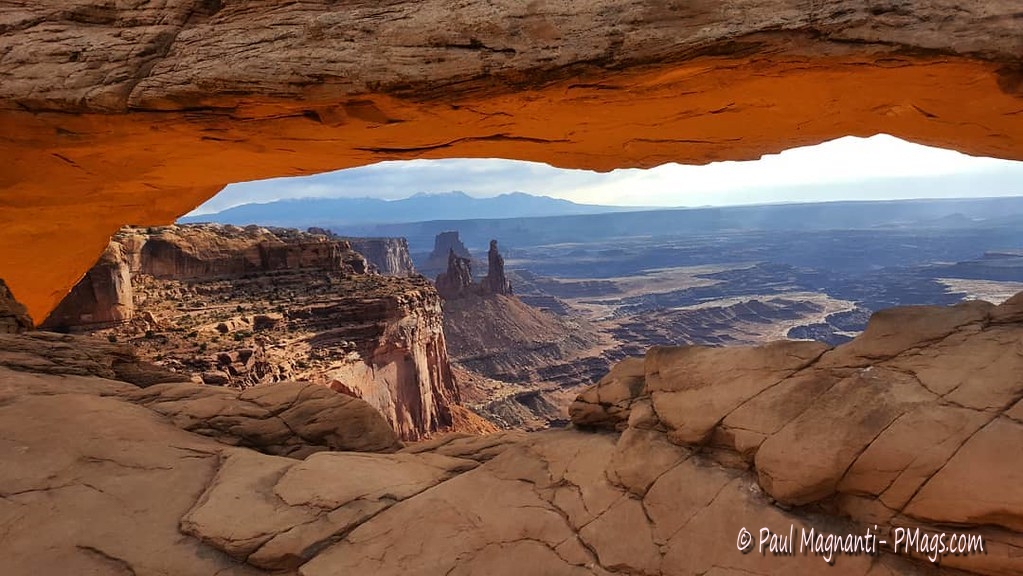
How about an arch of Moab? The well-known Mesa Arch. Many might know this photo as Windows 7 wallpaper.
I do believe history eventually rights itself.
The previous Gilded Age gave us the Progressive Era with political reforms, worker protections, expanded voting rights, more public lands, and consumer protections.
A brown-colored fecal rainbow with a pot of gold at the end.
We sit in the middle of that arc now. It is not fun.
A crude metaphor, perhaps. But in the end, things get better.
“We must accept finite disappointment, but never lose infinite hope.”
Well Said,,,
Preach it! I have felt my favorite National Parks being loved to death in the Tetons, Rocky Mountain, and elsewhere, but nowhere more than Moab, with its combination of “trophy” mass-tourist parks and OHV-friendly public land surrounding them (UTV rental should not be a thing…). I can’t imagine living there these days.
Honestly, the secret sauce of Moab is how much is concentrated into a few areas.
Unlike my Colorado Front Range days, it doesn’t take literal hours of bumper-to-bumper traffic to get in and out.
Joan and I can still reach places in under 30 minutes, park, and not see anyone all day.
There are challenges in town, for sure, but for us Moab is more basecamp than the experience itself.