
In the vein of the historical soap opera Downton Abbey, there is a newer show titled The Gilded Age.
It is not about our current Gilded Age, but about Gilded Age 1.0. Robber barons instead of tech bros. A lot of opulence. A huge gap between the haves and the have-nots. A corrupt government.
Though I have not seen the show, apparently, much of it takes place in Newport, RI.
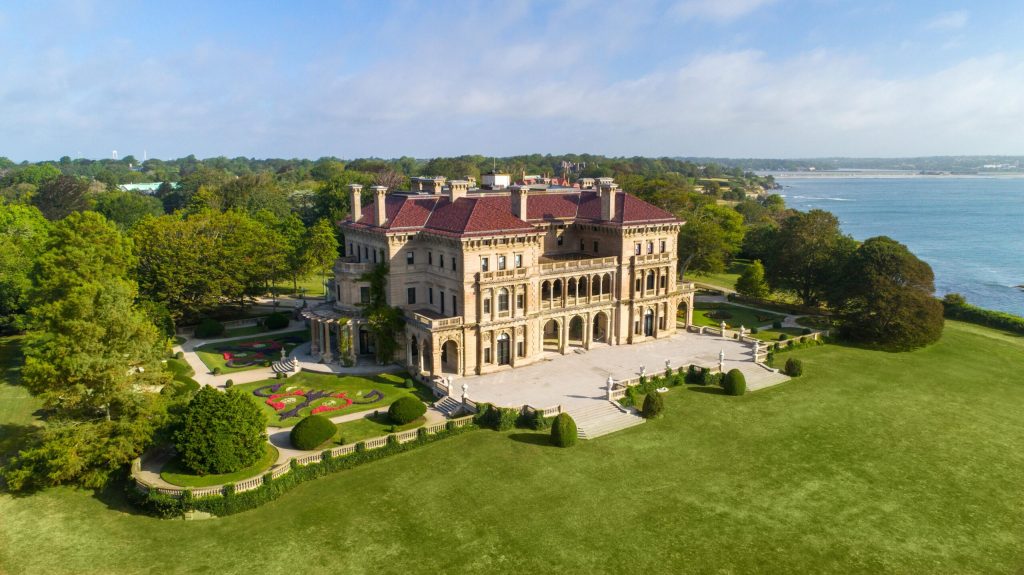
The Vanderbilts’ “summer cottage.” The Breakers Mansion. From American Essence.
Even growing up in the 1980s, Newport was full of wealth. There still is.
Growing up, Newport felt exotic. It was the place you went for a special outing.
The large naval base, gone for over a decade, and the gritty waterfront gave way to shops, sailboats, and scenic coastline. You reach it by driving over a stunning bridge that my grandfather helped build before he retired.
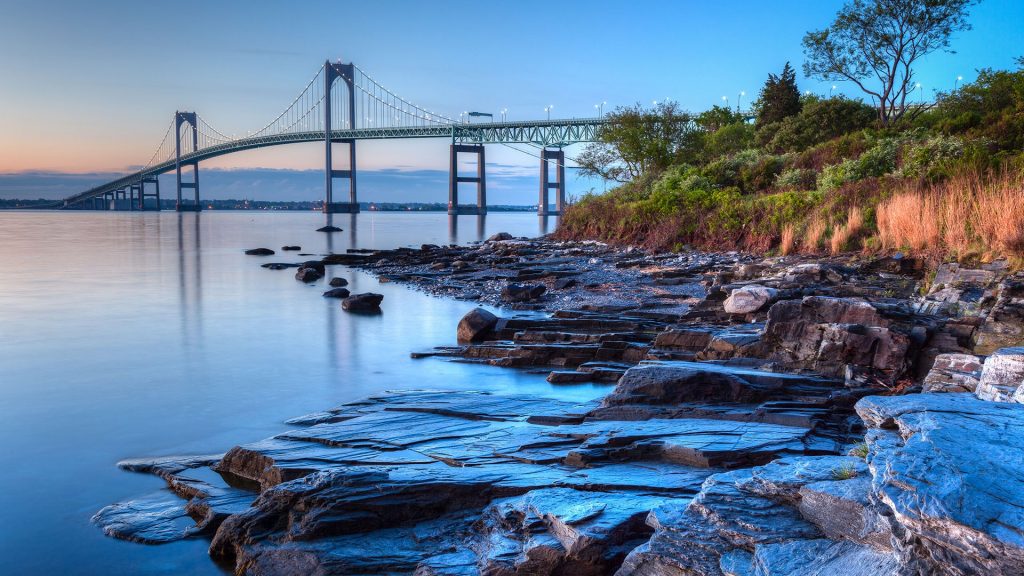
From Windows 10 Spotlight.
Newport was also the destination for some of our elementary school field trips.
We would tour one of the mansions, learn that Robert Redford filmed The Great Gatsby at Rosecliff Mansion, and then the bus would take us to Brenton Point State Park for a picnic lunch. Afterward, we would head back over the bridge to our school in an old mill town.
One trip took us to The Breakers Mansion. The Vanderbilt “summer cottage.”
We boarded the bus. No uniforms required that day. The adult chaperones, mostly our moms, accompanied our teachers: some lay teachers, some nuns.
The tour guide took us to what could best be described as a switchboard room. A staff person stayed there 24/7. When a plug came out of a labeled room on the board, a servant answered the call. Tea. Wine. A bed changed. Whatever the wealthy family needed. The staff worked downstairs, far from the opulence above.
Sr. Lorraine shook her head.
Then the guide brought us to a room filled with Italian marble.
Sr. Lorraine’s class included names like Licciardi, Petrarca, Florio, Pendola, and Magnanti. Our ten-year-old selves perked up a bit; we felt a little proud that the marble came from Italy.
The guide told us how much all that marble cost.
Sr. Lorraine shook her head again and said,
“Imagine what that money could do for the poor people.”
Sr. Lorraine was not “woke.” She had firm standards. She chastised me when I proceeded down the aisle for communion with my hands in my pockets at Mass. She spoke against abortion. She believed people “living in sin” acted immorally.
But she also taught us something else. – Serve the community, help the poor and disadvantaged, and do the right thing whether anyone notices or not.
That is the mission of the order. The same order runs a university that originally educated the daughters of French- Canadian mill workers and other economically disadvantaged families.
Today, the school is co-ed. The mission remains similar –
“…teaching and serving the poor by making social justice and service to others a special focus of its work.”
and to prepare
“students for lives as servant-leaders in an increasingly interdependent global community, where understanding and engaging with others is essential not only to individual success but also to a stable and sustainable world.”
Not long after that mansion visit, we likely sang “Whatsoever you do to the least of my people, you do unto me” at our monthly Mass.
View this post on Instagram
Those lessons reached children whose parents worked as nurses’ aides, truck drivers, sheet metal workers, retail clerks, and employees at the local soap factory.
Today, someone would probably call those lessons a “woke liberal agenda.”
But lessons are not liberal. And they are not conservative.
They are values – Serve the community. Care about the common good. Let people access what belongs to all of us. “Caring for our common home.”
There are increasing signs that public lands may become more exclusive. Access favors those who can afford guides, airfare, hotels, fuel, and the ability to take blocks of time off.
Public lands are increasingly managed by corporatists who view them primarily as economic resources to exploit. These places risk becoming playgrounds for the affluent. Taxpayers still subsidize them.
I have often said that a twelve-year-old version of me today would not have the life-changing trip to New Hampshire. I suspect the chances are even lower now.
When a kid from the city never sees the outdoors, you lose a voice.
When a father cannot take a Saturday off to bring his child outside, another voice disappears.
When a mother cannot afford to chaperone a hike to Delicate Arch because Moab is too expensive and the drive from Green River is too far, that daughter never even gets the chance to become a voice.
If fewer people experience the outdoors, the people visiting public lands become increasingly similar.
A Professional Managerial Class (PMC) travels to these places, gets internships because their families can support unpaid work, and eventually manages those lands.
Many of those same PMC professionals measure success through metrics, resume lines, and optics. Advancement comes from accommodation rather than confrontation. Speaking up carries risk.
So when something runs counter to the mission, fewer people are willing to say so.
“…to conserve the scenery and the natural and historic objects and the wild life therein and to provide for the enjoyment of the same in such manner and by such means as will leave them unimpaired for the enjoyment of future generations.”
That mission does not talk about maximizing revenue. It does not mention corporate partnerships, access systems, reservation algorithms, or speaking up against mandates that are counter to the mission. The mission does not refer to people who manage the lands as “valuable resources.”
It talks about conservation. And it talks about the public.
Instead, PMC corporatists manage through accommodation, KPIs, and whatever looks good to their superiors.
Other voices disappear.
Different racial backgrounds. Different economic backgrounds. Different cultural perspectives.
This cuts across politics.
I once worked for a company that proudly described itself as progressive. The PR manager decorated his office with the correct liberal quotations. The company made a public show of donating shoes to local children. Cameras came along for the photo opportunity.
Exploiting children to advertise progressive values for a company selling products to affluent consumers would not impress the nuns who taught us about “The Widow’s Mite.”
Land management agencies talk about diversity and inclusion. In practice, the system increasingly favors economic, social, and cultural privilege. Access requires navigating reservations, technology, transportation, and time off. Those requirements filter who gets to participate. And the people who established their careers by playing the game correctly have no interest in changing the status quo.
Ed Abbey once wrote,
“A journey into the wilderness is the freest, cheapest, most nonprivileged of pleasures. Anyone with two legs and the price of a pair of army surplus combat boots may enter.”
Today, that line feels almost quaint.
You need a computer to make reservations. A car to reach the trailhead. Knowledge and exposure to even understand what waits out there.

From Seton
The Mission 66 effort once expanded public lands and infrastructure for the growing middle class. It opened access beyond the wealthy and affluent who had dominated recreation earlier.
Instead, the conversation is increasingly shifting toward Project 2025.
But the trend toward exclusivity has built slowly for years.
I was lucky. I encountered public lands early by happenstance. That exposure changed my life. I was also lucky to fall into a trade that let me keep living that life, thanks to another no-nonsense nun who believed in her mission, not the optics.
Public lands increasingly feel like places for the few. Places for the affluent. Places for people with similar backgrounds.
Our shared resources now concentrate more wealth for fewer people. And the access that comes with it.
Sr. Lorraine would have had something to say about that.
You are amazing Mags!! I agree with all you say! Proud of you!!
Thanks! Just some middle aged dude wool gathering. 🙂
you nailed this one Grew up in the open air of the majestic of the national parks, seems they got overrun overnight with all the complication associated with any visit now. thanks, great insight