
When a measure becomes a target, it ceases to be a good measure. – Goodhart’s Law
In the past months, I’ve watched perfectly sincere questions from newer hikers who get chastised and almost chased out of a virtual room by torches, pitchforks, and a few rotten tomatoes.
The transgression? Asking something that didn’t quite line up with the accepted answers.
Nothing new for online discourse, but still troubling to me in many ways.
There was a time when ultralight backpacking was a method—a practical way to walk with less wear and tear, with walking itself as joy, rather than toil.
But now it often seems to be about orthodoxy and ensuring the correct answers get passed on, rather than using ultralight gear as tools in a kit.
Ultralight gear and techniques have been part of my tool kit for a while; I thru-hiked the CDT in 2006 with a sub-10 lb baseweight. That still passes today’s exam. And I may even have had a small part in popularizing some of those methods.
Which is precisely why the enforcement now troubles me.
What should be about moving efficiently and getting immersed in the landscape becomes more about identity and “the correct” way to do something.
My own shift toward ultralight didn’t come from ideology. It came from being tired of long walks turning me into a pack mule.
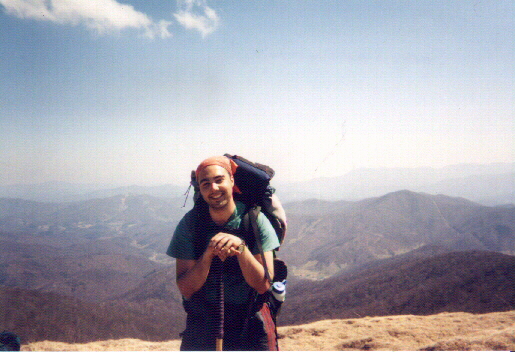
On the AT back in 1998.
Without exaggeration, the Appalachian Trail changed my life. But I also schlepped way too many pounds, wore leather boots, carried excess gear, and shoved it all into a monster 90-liter pack. After carrying that beast for five months, I vowed not to do that again.
Like many hikers of that late-1990s internet era, I stumbled into frameless packs, tarps, alcohol stoves, and trail runners through early forums and trial and error. I walked Vermont’s Long Trail with a sub-15 lb kit. By the time I hit the CDT in 2006, I’d pared things down even further.
But the weight was never the point. The walking was the point. Lowering my base pack weight made for a more minimal kit and a more immersive experience in the wild places.
That’s what gets lost now by some of the louder voices.

Somewhere on the divide in Montana. The bulge is from 3 liters of water.
Over time, a toolkit became yet another metric to hit—something less a tool than a set of tenets of a faith.
Now there are:
- Correct answers and wrong answers
- Approved shelters and disapproved ones
- “Canonical” brands and ones that don’t make the cut
- Base-weight thresholds that operate like moral judgments
At some point, the method stopped being about solving problems and became more about applying the correct doctrine.
And, just like real life, the loud minority dictated the faith rather than the quiet majority of practitioners.
In my previous post, “Ultra-light but not ultra-precise,” I made the point that:
“Twenty pounds or less is considered lightweight · Ten pounds or less is ultralight · Five pounds or less is considered super ultralight.”
But I followed that by arguing that those numbers are benchmarks, not the goal. Metrics have a place. They help you understand trade-offs and help set expectations.
I’ve also seen the counter-argument that your needs determine whether you “qualify” as ultralight at all and that certain choices automatically place you outside the UL framework. I don’t buy this logic. It still assumes there is one fixed version of “UL” that you either pass or fail.
And that assumption is part of the problem. Methods aren’t entry requirements. They’re adjustable tools. The goal isn’t to conform to a category; it’s to choose tools that match the conditions, the partners, the risk, and the experience you’re actually after.
When metrics themselves become the measure of value and cloud judgment, they lose meaning.
Goodhart’s Law comes into play: “When measure becomes a target, it ceases to be a good measure.” That holds whether you’re talking corporate KPIs or grams in the backcountry.
In other words: Use numbers as a tool, keep them honest, but don’t mistake the numbers as the point of your wanderings.

Way back in 2010, I wrote my thoughts and framed my take on ultralight more as a minimalist philosophy.
In it, I described what ultralight meant to me then: not as an identity but as a way to pare down the gear to the essentials.
“I do not consider myself an ultralighter. To me that term employs too much gear-wonkery. Where the emphasis is on gear and not enjoying the trail.”
I called myself a minimalist by choice, not a gearhead by dogma. I carried just enough for comfort and safety — no more, no less. Often, under three-season conditions, I ran a minimalist kit. When the context changed (heavier water loads, packrafting, desert climate, winter trips), I adjusted appropriately.
Because gear is a tool, not a badge.
That philosophy held up then. It still does now. But as the community and culture have grown, the louder voices drown out the principle, making people new to the outdoor community feel less welcome, less likely to learn, and less likely to grow in confidence and in outdoor pursuits—a loss for everyone.
The accepted “UL doctrine” online tends to assume a narrow use case:
- Solo
- Three-season
- Well-maintained trails
- Predictable weather
- A specific demographic
Step outside that lane, be it desert hiking, winter trips, couples trips, packrafting, off-trail routes, guiding, budget concerns, and suddenly the rules don’t fit. Instead of adapting the framework, the framework gets defended. Context becomes heresy.
I see beginners worrying more about whether their shelter is “acceptable” than whether their water plan makes sense for the environment. I see specs treated as a universal truth while local knowledge and judgment become anecdotal.
That’s backwards.
In my AMA, I described my mindset as:
I think of myself as a minimalist with a practical bent. Meaning, I take less, tend to make do with what I have, and like the gear I don’t have to futz with overall. If I have to think about the equipment (be it too many straps or because of it being fragile, for example), the gear does not work for my system.
I also think of gear not as individual pieces but as a tool working in a kit for a given task. If my task is three-season backpacking in dry and cold condition overall, I want my tools to work well together for that kit.
Those lines still sum it up.
Numbers give the illusion of certainty but do not replace knowledge of terrain, trip types, or local conditions.
Judgment doesn’t come from spreadsheets.
Loud, prolific posting and the regurgitation of numbers don’t create experience – they only create the illusion of expertise.
The newest hikers often pay the price of rigid orthodoxy, usually from people proselytizing without real experience. Instead, the newcomer would benefit most from nuanced and thoughtful guidance.
They get told what to buy instead of learning why to buy it, and they learn rules rather than what to experience.
Buying tools replaces experience, and a consumerist ethos holds instead.
What a favorite book said about technology equally applies to gear and consumption as well –
“When a new technology is applied to the backcountry, we tend to focus on its practical uses. When someone later points out a gadget’s impact on the quality of the wilderness experience, we tend to classify such ramifications “secondary” or “side effects” of the technology’s application. By taking this view, we preclude questioning the original, intended use of this technology. But in fact the changes that a new technology makes on the wilderness experience are not all secondary, but are intrinsic to the very nature of that technology. The medium is the message. The tool becomes the experience.”
Tools aren’t the experience; they help enable it when we have the opportunity.
As I said many times over the years –
“I firmly believe the ‘gift of time’ is the best asset for any outdoors person.”
But time is precisely what the ultralight dogmatists often sell short. Gear sales, spec regurgitation, and “optimization” rarely value time. Much like some fancy acronym from the corporate world, it sells the process and ignores the practical results that get lost when trying to fit a specific paradigm.
When that happens, walking becomes a math problem rather than a practice. And that’s precisely when hiking begins to lose something essential.

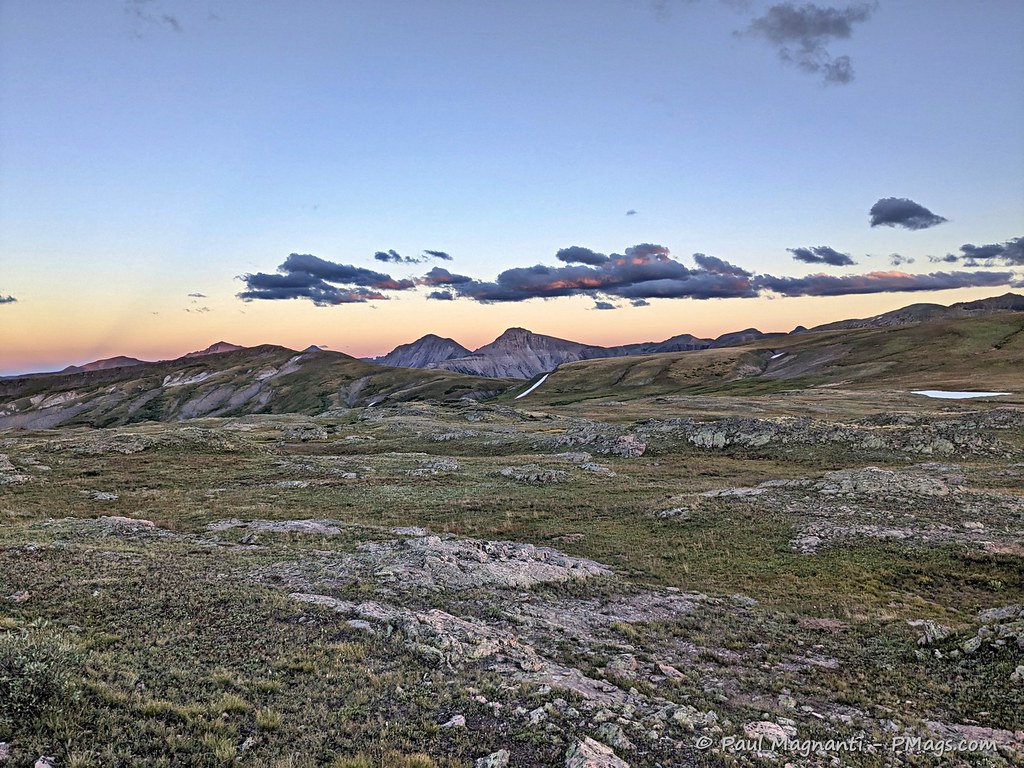
Pictured: Delightful Scenic Way Awesome Pass, somewhere in the backcountry.
If I were to launch a counter-reformation, it would go like this:
- Teach skills before counting grams
- Share methods, not commandments
- Let trip context outrank dogma; always
- Spend more time outside, argue less
- Gear is a tool, not an identity
- Time outside beats time optimizing; you will optimize by going out more.
These ideas don’t translate into neat spreadsheets. But in the outdoors, these ideas are what will hold up trip after trip, year after year, and decade after decade.
Despite everything above, I’m still a believer in ultralight as a process and as a method. The process lets me carry less and move lighter on the land, putting me in a place where I concentrate on the experience rather than the toil or the tools I use.
But I don’t believe in turning it into a belief system.
What I wrote recently may be my credo after almost three decades of immersing myself in the outdoors – Ultralight isn’t about the lightest number; instead, it’s a flexible toolkit for carrying just enough to stay safe, adapt to conditions, and be fully present in the experience.
Ultralight works best when it’s quiet, adaptable, and grounded in use. It fails worst when it becomes a performance culture with the language of a corporate philosophy plastered all over the experience.
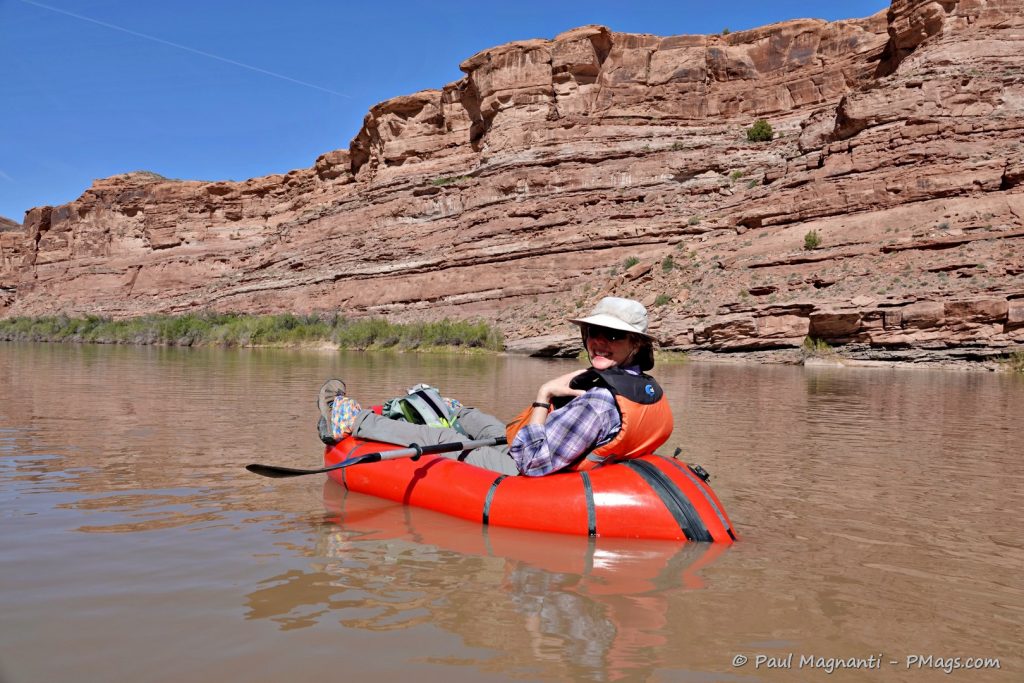
When I look back at photos from my traditional thru-hikes, I don’t see rules.
Instead, I see myself evolving, adapting, and refining not just my gear, but my skills, my processes, and even my outdoor experiences.
I walked along ridgelines, had quiet sunsets, and cold mornings with hot coffee. And now I often share it all in a way I did not in previous years.
That’s what draws me outside. Not the number or the gear debates and certainly not the catechism.
I go for a walk, I make mistakes, I pay attention, I adapt, and I walk some more.
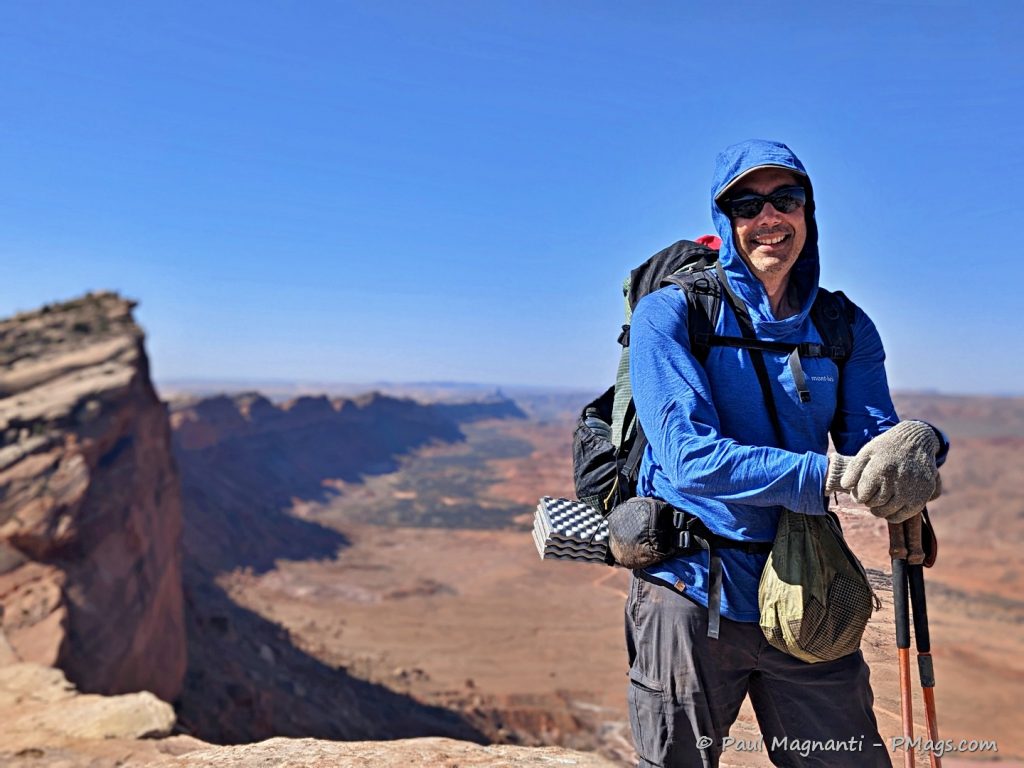
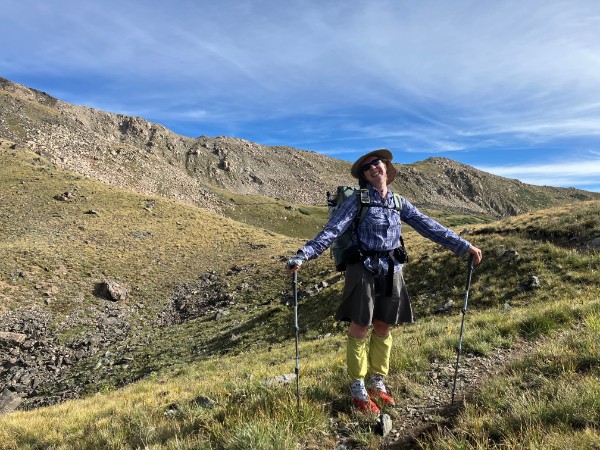
On a ridge for some late spring desert backpacking. From Joan.
Still curious about his whole concept? Here’s my take
The accepted “UL doctrine” online tends to assume a narrow use case….
This can not be overstated. You make an important point that goes completely unmentioned by many ul zealots. I’d narrow it down even further from “three-season” to “one-season per place”
I listen to some UL PCT influences say it almost never rains in the Sierra, and ground insulation is barely necessary. My reaction is “Ah. You’re only there in July and August.”