
Over Easter Week, Joan and I visited her folks in the upper Midwest.
Though Joan spent her formative years around Portland, OR, and her teens in Maryland, I joke that she is a Midwest American.
My in-laws grew up in Chicago. My father-in-law spent summers at the family farm in Wisconsin and attended Ripon College. His Boy Scout troop camped not far from where they now live in Portage, WI. Much of their family still lives in the Chicago area and across the upper Midwest.
So retirement in Portage, WI, never seemed like an odd choice.
Portage exists because of geography as much as history. The name comes from the short portage between the Wisconsin River and the Fox River, a key link that once connected the Great Lakes to the Mississippi River system. Indigenous peoples, voyageurs, and early traders used this crossing to tie together much of the continent’s interior waterways.

Along the river walk in Portage, not far from the historical portage itself.
The surrounding area holds a surprising number of archaeological sites.
On our first day, we wandered the grounds of John Muir’s childhood homestead, walked a stretch of the Ice Age Trail, and took in a high point overlooking the area.

.
.

.

.

Different from our desert home, but a good place to stretch the legs.

The next day, and the last day of sunshine, we went to Devil’s Lake.

.
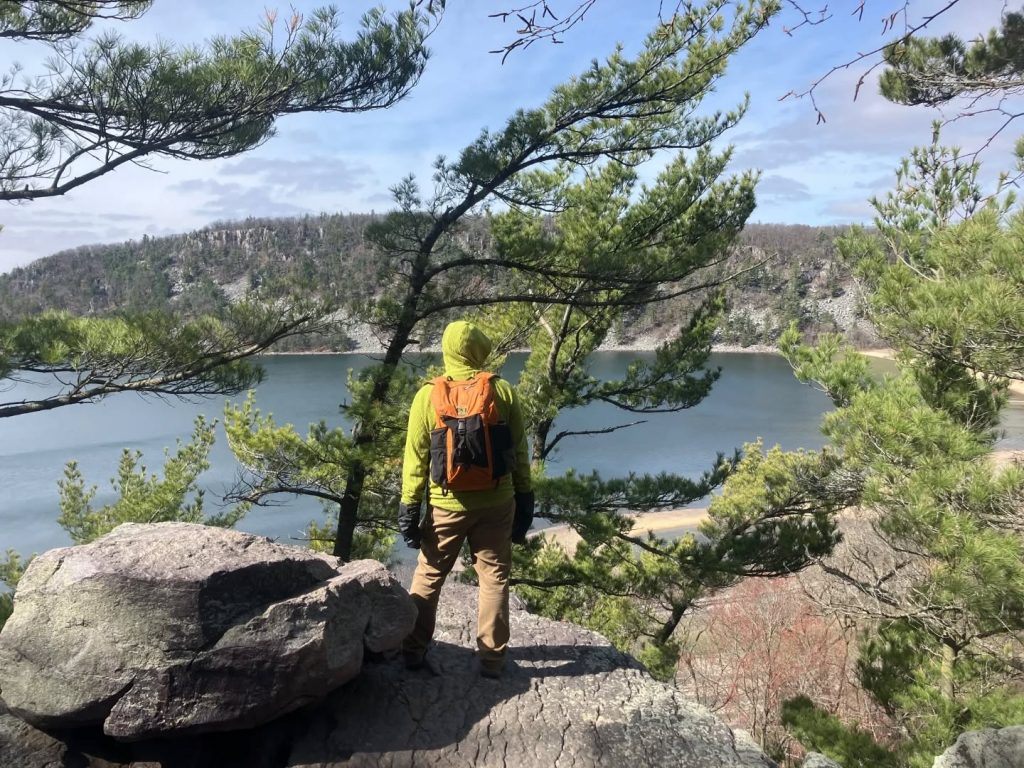
From Joan
Once a higher-end lodging area, it now draws hikers, campers, and picnickers.
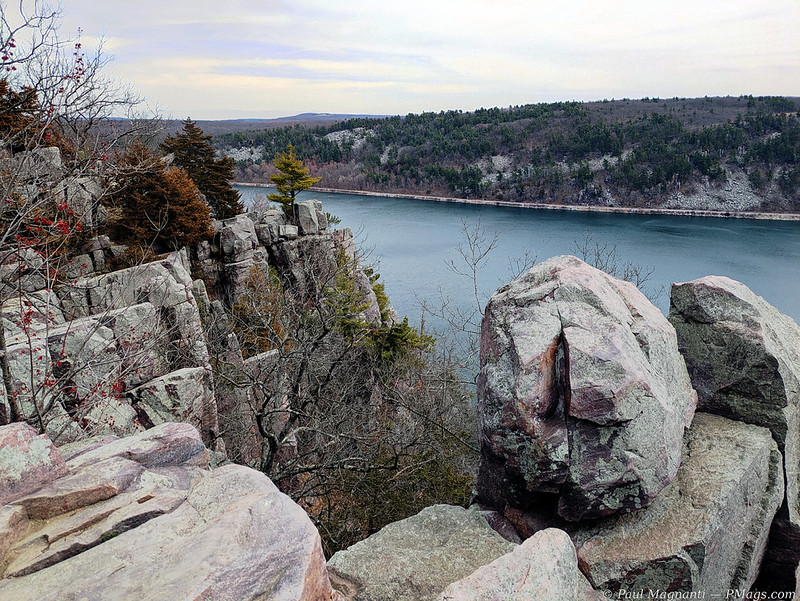
It also holds earthworks built by the Mound Builders around 1100 CE.

On the way back, we stopped at the Man Mound.

One of only five anthropomorphic mounds known in North America and the only one still in existence.

Rain moved in the next day. We caught a break and did some section hiking, of sorts, on the Ice Age Trail right from town.

We also visited the canal that once handled the portage work in more recent history.

By Royalbroil – Own work, CC BY-SA 4.0
Another day meant more wandering through woods and prairie.

A rare selfie with Joan.
We hiked along rivers, visited a landmark once used by voyageurs, and saw pictographs, petroglyphs, and mounds left by the ancestors of the Ho-Chunk people.

.
.
We went up the Roche-A-Cri Mound.

One of the steeper hikes in Wisconsin and a reminder that the “flat Midwest” is not quite so flat.

This region holds many ancestral mounds built around the same time as Pueblo sites on the Colorado Plateau.

On Good Friday, this lapsed Catholic unlocked a Wisconsin achievement. A fish fry at the local Knights of Columbus paired with a Wisconsin-style Old Fashioned.

.
That got paired with a coffee at Kwik Trip for full Wisconsin immersion.
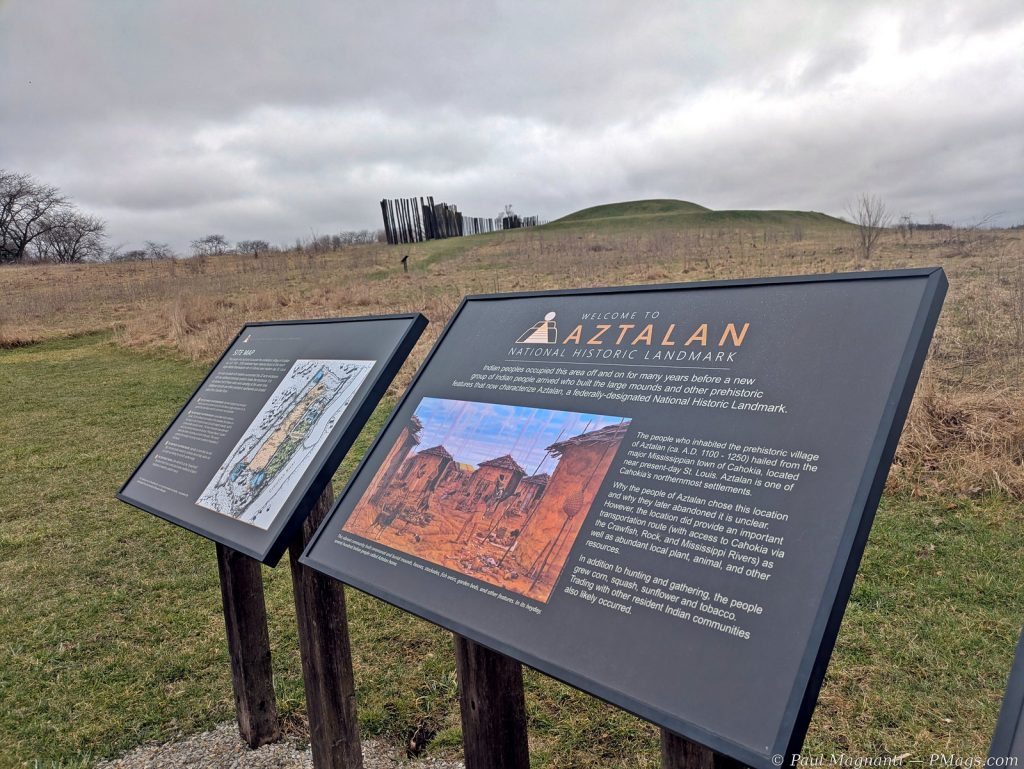
We spent one last day in Wisconsin. We visited Aztalan State Park, where ancestral mound builders established an outlier connected to Cahokia further downriver.
.

A few hundred people lived here and shaped a piece of history I did not learn about until well into my 20s. Standing there now, I found the place quietly impressive.

Joan plans to return in late August. The farther north you go in Wisconsin, the more remote it gets, and the Great Lakes region is supposed to be stunning.
I may join her for a future trip.
There will be a Kwik Trip stop or two, I suspect.
Thanks for sharing photos and stories from the great state of Wisconsin!
Yes, very hard not to come across a Kwik Trip in Wisconsin. Haha!